IS INTERNET FINALLY REUNITING INDIAN MUSLIMS & MUHAJIRS OF PAKISTAN: The Rising Internet subculture of Hindustani Musalman and the Third Space

Syed Kabeer Hassan
Published


Mujh ko diyar-e ghair men mara watan se dur
rakh li mere khuda ne miri bekasi ki sharm
[He] killed me in an alien country, far from [my] watan
My God kept intact the honor of my friendlessness
— Mirza Asadullah Khan “Ghalib” (1797–1869)
One photograph stays with me. Taken from a skewed, dingy angle, it captures an old building propped somewhere between earth and sky, with a dark flag waving silently above it, almost out of tune with the shifting tides of time. The walls are white, yet it never occurs to you that it actually might be for mourning. How could it, with all that empty space; the limitless canvas of the sky, the gentle bowing of the tree, the stillness that seems to stretch beyond the frame?
There is no obvious main character here, except for that dark flag. Everything else recedes into the background. If I could offer one revealing fragment, it would be this: the flag seems to be taking everything from the house, even as it tries to give everything back.
This flag belonged to the Muslim League, and the year was 1946. This was the city of Allahabad, which would find itself inside the boundaries of Post-Partitioned India. I know this because the house in the photograph is the house I live in.
I know this because living here as an Indian Muslim, the phantom of the border fences so far away from our city was demarcated even within our courtyard. You could see in the tidbits of the walls, the ghosts of the ones who departed proclaiming that they lived here once, that this was once also their home. For us, the generation living now, we carry their resemblances, their quirks, their manners, and smiles without ever knowing them more than their names. More than their existence, their actions frozen in some past now stay with us.
My great-grandfather was a member of the League and devoted himself entirely to its cause. His story follows a familiar arc in the history of Indian Muslims during Partition. He transferred his savings and business dealings to Habib Bank in Karachi and even arranged for a property there. Everything was prepared for migration. Yet on the day of departure, my great-grandmother gripped the legs of her cot and refused to move.
"Merey baap dada yahin dafan hai! Meri duniya yahin maujood hai, aapko jana hai toh jaayen, mey is dar ko nahi chodungi!" (My father and forefathers are buried here. My whole world exists here. If you want to leave, then leave. I will not abandon this doorstep.)
And she didn’t leave. Neither did he.
Had I been my great-grandfather then, a man who had done everything for the creation of a state he would never live in, who had transferred his entire savings into the Bank that overnight became foreign, I might have searched for someone to blame. I might have cursed the speeches that urged Muslims to stay, especially the famous address delivered by Abul Kalam Azad at Jama Masjid. But history is rarely altered by a single speech. What kept people rooted was something deeper: attachment to the land, to family graves, to familiar streets, to neighbors, to routines so ordinary they seemed invisible until the moment they were threatened. In the end, the decision was not shaped by ideology alone. It was shaped by the daily texture of life itself.
And so my great-grandparents made a choice that would echo through generations. They decided that this was their country, and that nothing, not borders, not slogans, not the promises of a new state, could change that. One night, the Muslim League flag was quietly lowered from its pole. In its place remained something less visible but far more enduring: a faith that they belonged where they stood. A dream had come and gone, but the house remained, the land remained, and so did they.
Meanwhile, the people who left, in counts of millions, were also us. On foot, trains, carts
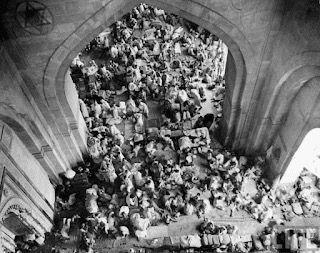
– they reached various parts of newly formed Pakistan. Sindh became their respite; Karachi accommodated most of them. They came to be known as Muhajirs. The term was previously alluded to the migration of the first Muslims from Mecca to Medina. The state of migration turned them into pilgrims rather than refugees. The people already living in Pakistan were enacted as the Ansars, who provided hospitality to these pilgrims, fulfilling their quasi-religious duty.
As the years passed, the term Muhajir gradually morphed from being a sympathetic term for migrants to a medium for alienation. The term in itself became an element used for subjugation. Noting the shifting meanings of Muhajir, Oskar Verkaaik writes: ‘Once it had meant “welcome”, now it meant: “you are not from here”. In the 1970s, fairly visible instances of such started taking root. The rise of MQM (Muhajir Quami Movement) led by Altaf Hussain attracted repression from the state. Its members and supporters saw its rise as that of a revolutionary party made to safeguard the rights of unprivileged sections of Muhajir identity. Then in 1992, Nawaz Sharif launched Operation Clean-up, and conjured one of the most oppressive army operations against the Muhajir population. House checkups, bureaucratic isolation, arrests and encounters took place at a mass level. Corralling every member of the Muhajir community into solidarity with each other, and stifling their identity into an invention of a Qaum, an ethnic identity in themselves through their shared diaspora. Once depicted as the most self-sacrificing people who ensured the successful formation of the state of Pakistan, were now perceived as unwanted refugees.
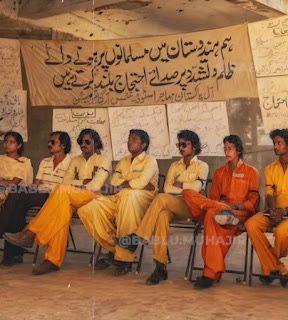
On the other hand, Muslims in India, now further reduced, struggled for their own identity and stability. The curious case of Hindustani Musalmans is actually a case of anxiety that kept repeating its cycle of struggle. They have been fighting for representation on both sides of the border. Needless to say, ever since Independence, the conditions of Indian Muslims who stayed back in India have only deteriorated in inexpressible ways.
Muhajir hain magar hum ek duniya chhor aaye hain,
Tumhare paas jitna hai hum utna chhor aaye hain.
Kahani ka ye hissa aaj tak sab se chhupaya hai,Ke hum mitti ki khaatir apna sona
chhor aaye hain.
— Munawar Rana, MohajirNama
During the early days, the families divided between these two states could meet each other, could take a train to each other’s cities, attend weddings, hand each other Eid cards, and have delightful summers in their farmlands together. But soon, nearing the 1990s, with a growing presence of a new form of Hindutva communalism in India, and growing tensions between these states, nobody could further imagine things to be the same anymore.
What happens when this identity clashes on the internet, where there are no borders? The sociologist Homi Bhabha coined the term "Third Space" to describe a cultural in-between: a zone that is neither the original home nor the adopted one, but something that emerges in the negotiation between them. It is a space that destabilises fixed identities, that allows hybrid and fluid forms of belonging to exist.
For decades, the Hindustani Musalman identity, belonging fully to neither the India that suspects it nor the Pakistan that has largely absorbed and then marginalized it, had no Third Space. The physical space of undivided northern India was gone. The social space of a shared neighbourhood was severed. The political space was actively hostile on both sides.
What the internet did, almost accidentally, was create exactly this Third Space. In 2025, there was a noticeable surge in Instagram accounts that pointedly centered around the Hindustani Musalman Identity. These were meme pages, the kinds of which we hadn’t seen in the previous years. This was a modern weapon of something that could be understood as a Memetic Warfare. These pages mobilised the followers on the grounds of the cultural grandeur of their community, glorified its leaders, even at times downcasting other cultures to scripturalise their identity.
We cannot ignore the relevance of memes in our modern consciousness; they are the swiftest media that we have yet perceived. It is the architecture of transmission of information in our age. In an essay ‘It's time to embrace Memetic Warfare’, Jeff Giesca conceptualises how Memes could be better used as a means of cyber warfare. He says, “Memetic warfare is about taking control of the dialogue, narrative, and psychological space. It's about denigrating, disrupting, and subverting the enemy's effort to do the same.”
What makes these pages distinct from ordinary nostalgia accounts is their refusal to be merely elegiac. There is an almost aggressive quality to the pride on display, which makes sense when you understand that pride itself has been made politically dangerous for these communities. To post about the magnificence of Urdu culture, to claim it loudly and without apology, is for an Indian Muslim a small act of defiance against a political climate that wants them to be ashamed of exactly this. For a Muhajir, it is a refusal to accept the provincial second-class status that Pakistani ethnic nationalism has tried to assign them.
I had the privilege of having a conversation with some of these accounts that are quite renowned in this subculture:
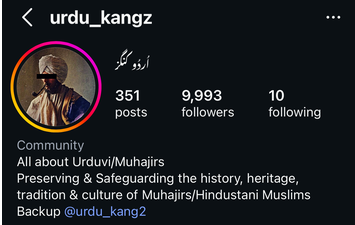
One of the accounts is @urdu_kangz on Instagram. Much of the content is focused around the culture of the Hindustani Muslims. From Sherwanis to Kebabs to Urdu as a language, which nearly transformed the entirety of Pakistan. It highlights the Hindustani Muslim faces in various industries such as Fawad Khan, Mehdi Hassan, Zia Mohyeddin, Saadat Manto, and many others. It also has a lot of content revolving around the history of the Gangetic Plains, as this is where a lot of Muhajirs find their origins to be. One of the fascinating things about these accounts is that you’ll always find something pertaining to pre-Islamic India in their works, as they refuse to diminish that part of their cultural identity.
Talking to Urdu_Kangz led me to Syed Rafay Ali, who was instrumental in the entire movement.
May I know where you originate from? And what was the first cue that made you enter this space? I know for sure that since you trace your roots outside Pakistan, it would have acted as a slow burn, but was there any incident where you were incited to be more vocal about this identity?
SRA: If I were to give you a brief about my origin, my family belongs to Lucknow, our family is that of the Rajawara of Nanpara. My great-grandfather was a follower of the ideals of the Muslim League and was also a government employee, and so he migrated, and we also got our quarters there. After the death of Bushra Zaidi in Karachi, and the surge of MQM, following my father’s active presence in the resisting community, naturally the brunt of all this injustice came down on me. This slow transformation is what converted Pakistani nationalism inside of us into Muhajir nationalism, meaning those people who used to take pride in being Pakistani started taking pride mostly in our community, which migrated.
On the entire ecosystem of the growing Muhajir and Hindustani Muslim-centred pages, I laid the basic foundation. Being politically active since childhood, when I came on the internet, I took in a lot of observations with me. Sindhis, Punjabis, all other such ethnicities were running their nationalist pages, and we, Muhajirs, had nothing to combat that. And most importantly, the Sindhi nationalists had run a propaganda campaign around us, denigrating us to the status of beggars who had come from outside, who were under merciful refuge from them. Then I looked at my phone and wondered what I could do to counter all this for my community. And I worked tirelessly, making edits after edits, because I understood the power of this media. It took me 2-3 years of hard work to reach here.
Now with God’s grace, we have a huge group of friends who all work for the same cause. And one other primary reason was to unify Indian Muslims with us again. The Indian Muslims sitting in UP, Bihar, Bhopal, they are all from our community. We have the same blood, language, lifestyle, and tehzeeb. The only difference is that my grandfather migrated and theirs did not. So I aimed towards ending this disconnect through the means of the internet.
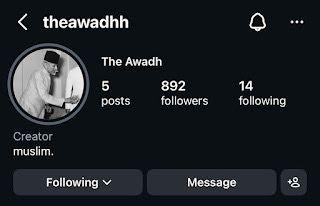
Similarly, there are also India-based accounts in the ecosystem which are fighting their own battles. @theawadhh is one such account, handled by a girl from Lucknow, who also manages @pashtunawadh that caters to her Pashtun ethnicity. @theawadhh’s posts stand in rebellion to the Indian government’s repression and the lack of Muslim representation in the polarised Indian society. Her posts resurface the under-recognised elements of Muslim culture in India, specifically Awadh (Lucknow). Her pages translate identity into the language of contemporary digital femininity: pastel shades, the visual grammar of Barbie packaging, the aesthetic of girlhood and smuggle serious cultural commentary inside it.
She describes switching to this mode because the comments on overtly political content were disheartening, a deeply honest admission about the real cost of visibility for Muslim women speaking about Muslim identity in India's current political climate, and the racism involved in understanding the cultural contribution of the Muslim populace.
Roger Brubaker's framework for diaspora: dispersion, homeland orientation, boundary maintenance helps explain why this project has such urgency. The Muhajir community satisfies all three criteria. They are dispersed. They maintain an orientation toward a homeland (the Gangetic plains, the cities of UP and Bihar) that they cannot physically return to. And they actively maintain a boundary, a sense of who they are and who they are not against the pressure to simply dissolve into the broader Pakistani identity.
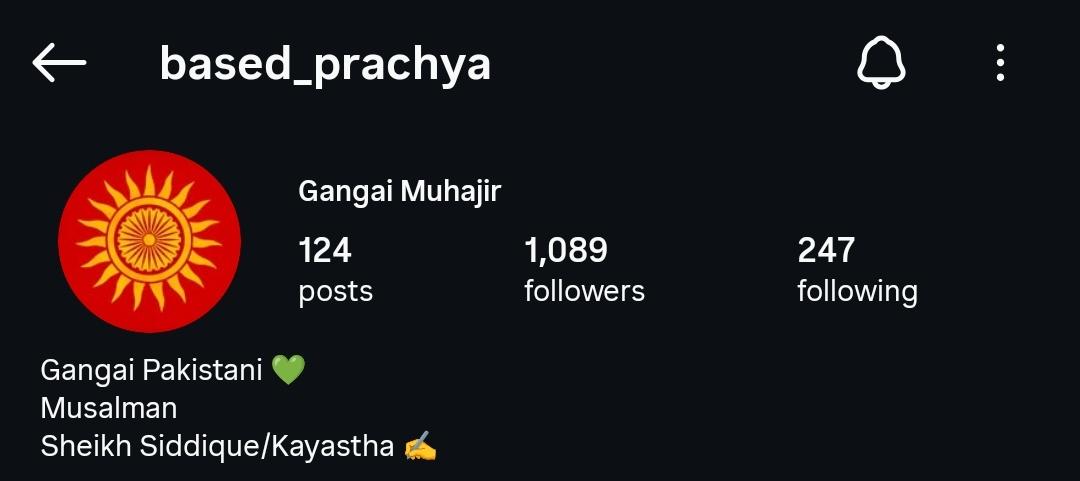
But what is striking about this internet subculture is that it extends Brubaker's framework across the border, drawing Indian Muslims into the same structure of feeling. The @based_prachya account's use of the title "Gangai" is emblematic of this. The Ganga becomes a mnemonic device, a way of anchoring identity to a geography that exists simultaneously in the physical world and in the collective imagination of everyone who came from its banks or descends from people who did. When a Muhajir in Karachi claims the Ganga as his, and a Muslim in Lucknow who has never left India also claims it, they are meeting in the geography of memory rather than the geography of the state.
ab to yahan ke mausam mujh se aisi umiden rakhte hain
jaise hamesha se main yahin hun ganga ji aur jamna ji
amrohe men ban nadi ke pas jo larka rehta tha
ab voh kahan hai, main to vahin hun ganga ji aur jamna ji
Now the seasons here have such expectations of me
As if I have always been here, o Ganges and o Yamuna
The boy who used to live in Amroha by the Ban river,
Where is he now? I am still there, o Ganges and o Yamuna
— Jaun Elia
It might not be well placed to suggest that meme pages are going to resolve the India-Pakistan conflict, or undo the structural marginalization of Indian Muslims, or restore Muhajirs to the political dignity they were denied in Pakistan. The state is real. The hostility is real. The surveillance, the violence, the discrimination- none of this evaporates because two communities are connecting on Instagram.
But something is happening that is worth taking seriously. For the first time in perhaps two generations, a significant number of Gen Z on both sides of the border are actively constructing a shared identity, not the identity of two nations learning to co-exist, but the identity of one people who were divided and are feeling their way back toward each other. They are doing it not through politics but through culture, through affect, and through the ungovernable, borderless space of the internet.
Maulana Nomani, in his works, writes about the three women who are regarded as adarsh (in terms of purity and morality) in the entire world: Mary, Ayesha [RA] (Prophet’s wife), and Sita. Accusations have been hurled on the character of all three. For Mary and Ayesha, all the matters were cleared up. Sita’s matter, however, couldn’t be cleared up. Even though Ram was considered the man of most ideals, he didn’t absolve Sita of such an allegation.
While the construction of such a world that doesn’t solely revel in memory undergoes, Hindustani Musalmans on both sides of the border, like Sita, will go on with their daily ordeals, trying to prove their faithfulness. As Sita could only try to purify herself from the taint of abduction, Indian Muslims and Muhajirs have a load of stain from the Partition that they’d go on cleaning, until some dawn could arrive that might clear the sky into white and ultramarine and vivid, perhaps into the same sky from the picture of my house so many years ago and for a brief moment or two, we all would, irrespective of the borders; live loudly.
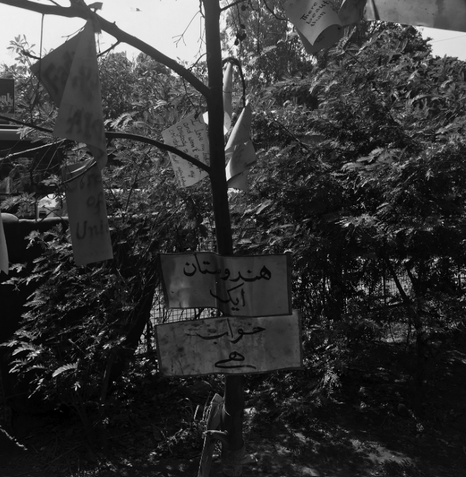
Hindustan Is a Dream artwork.
- Jamia Millia Islamia, March 2020.
This article is authored by Syed Kabeer Hassan, pursuing his B.A.LL.B (Hons.) in Law from Jamia Millia Islamia.
Edited by Omama A Talha
Disclaimer: The opinions expressed in this Publication are those of the author. They do not purport to reflect the opinions or views of The Jamia Review or its members.