In the first week of June 2026, the streets of Rawalakot ran loud with something Pakistan-administered Kashmir had not quite seen before. Not just anger, but organized, sustained defiance. Clashes broke out between protesters and security forces across Pak-administered Jammu and Kashmir, with demonstrators erecting roadblocks and organizing strikes while authorities deployed police and paramilitary personnel to contain the unrest. At least eleven people were killed and dozens injured, the majority of fatalities occurring in Rawalakot, in the Poonch district.
The immediate trigger was a Supreme Court ruling that the twelve assembly seats reserved for Kashmiri refugees residing in Pakistan were protected under the constitutional framework and could not be abolished without a constitutional amendment. The Jammu Kashmir Joint Awami Action Committee (JKJAAC) rejected this as yet another institutional maneuver that denied the people of Pakistan-administered Kashmir genuine political representation. Solidarity protests were simultaneously staged by the Kashmiri diaspora in London and Bradford. But this moment did not arrive from nowhere. It is the culmination of a cycle of broken promises that stretches back years and, if you pull the thread far enough, to 1947 itself.
The 2025 Azad Kashmir protests, which erupted in late September of that year, were described as one of the largest public uprisings in Pakistan-administered Kashmir's recent history. The movement, led by the JKJAAC, a coalition of traders, lawyers, students, and civil society actors, emerged in response to deepening economic hardship and perceived government neglect. Unlike previous protests that were largely sectoral or economic, this movement expanded into a multi-stakeholder campaign addressing structural governance issues: legislative reform, accountability, and local control over resources. It resulted in ten deaths and over a hundred injuries before the government claimed to have accepted most of the demands, claims that protest leaders flatly rejected.
The pattern is consistent and telling. In May 2024, following a lengthy march, the government agreed to reduce electricity and flour prices. However, other agreed-upon demands were not implemented. A subsequent agreement in December 2024 also went unfulfilled. By May 2026, negotiations had broken down again. For many campaigners, conversations appeared to yield paper commitments rather than genuine progress in practice. The JKJAAC issued a May 31 ultimatum, threatening a long march on the Legislative Assembly, and declared that proceeding with the 2026 elections in their current form would amount to a betrayal of the public. What is unfolding in Pakistan-administered Kashmir is not simply a protest movement over electricity tariffs or wheat prices. Those are the sparks. The fuel is structural, the accumulated weight of a population that has been administered, managed, and subdued, but never genuinely governed by its own consent.
The word "Azad" means free. It is among the more bitter ironies of postcolonial geography that a territory named for freedom has, for nearly eight decades, been neither free nor permitted to decide what freedom might look like for itself.
To understand why, you have to go back to August 1947. Not just to the Partition of British India into two nations, but to what happened in the weeks that followed. The princely state of Jammu and Kashmir, under Maharaja Hari Singh, was not immediately absorbed into either India or Pakistan. Singh hesitated. In that hesitation, both newly born nations saw an opportunity. When Pakistani-backed tribal militias invaded from the west, Singh signed the Instrument of Accession with India in exchange for military assistance. India sent troops. Pakistan refused to recognize the accession as legitimate. The dispute was referred to the United Nations. A plebiscite was promised, a vote that would allow Kashmiris to decide their own future, and it never came.
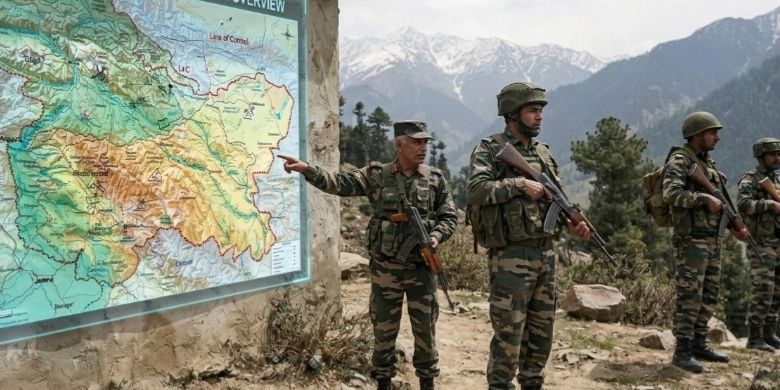
What came instead was a Line of Control that hardened into permanence: India administering the larger Kashmir Valley and Jammu to the south and east, Pakistan administering Azad Kashmir and Gilgit-Baltistan to the west and north. Two countries dividing between themselves a people who had been promised a say and given none.
This is the foundational wound. Not merely a territorial dispute between two nuclear-armed states, but a deliberate suppression of Kashmiri political agency at the very moment it might have mattered most. The plebiscite became a diplomatic ghost, invoked selectively, never honored.
What followed on both sides of the Line of Control was a particular kind of governance: one that performs legitimacy without delivering it. In Indian-administered Kashmir, the decades-long counterinsurgency, the revocation of Article 370 in 2019, and the effective downgrading of the state to a Union Territory have been extensively documented and debated. The suppression of political dissent, mass detentions, and the blanketing of the valley in surveillance are not contested facts. They are policies.
But the situation in Pakistan-administered Kashmir, precisely because it receives far less international attention, demands equal scrutiny. The name itself functions as a kind of propaganda architecture. It signals liberation while the structures beneath it tell a different story. The region of Kashmir administered by Pakistan is a unique territory that is both politically disputed and strategically significant, yet its residents have no representation in Pakistan's National Assembly, no independent judiciary in the fullest sense, and no meaningful control over the federal decisions that shape their daily lives. This includes the electricity tariffs they pay for power generated by rivers running through their own land, and the constitutional arrangements that determine who gets to vote for whom.
The JKJAAC's 38-point Charter of Demands is, at its core, a demand to be treated as citizens rather than administered as subjects. The fact that it requires a charter at all, that basic governance accountability must be extracted through street protest, long marches, and the loss of lives, tells you a great deal about the nature of the relationship between Islamabad and Muzaffarabad.
There is a tendency in coverage of Kashmir from both sides of the subcontinent to frame the conflict as being fundamentally between India and Pakistan. This framing is not wrong, but it is dangerously incomplete. It places Kashmiris as the terrain of a bilateral dispute rather than as its primary subjects. It transforms a people into a geography.
What the protests in Pak-administered Kashmir in 2024, 2025, and now 2026 make visible is that Kashmiris on the Pakistani side are not satisfied. They are not the liberated counterparts to their suppressed cousins across the Line of Control. They are a population with their own grievances, their own political agency, and their own reckoning to demand.
This does not flatten or erase the differences in the nature of control exercised by India and Pakistan respectively. Those differences are real and significant. But it does complicate the easy nationalist narratives on both sides: the Indian claim to normalcy and development, and the Pakistani claim to being the legitimate aspirational home of Kashmir's Muslim majority.
Neither nation has given Kashmiris what was promised in 1947. The right to choose.
Kashmir is not frozen in 1947. It is alive, and it is restless.
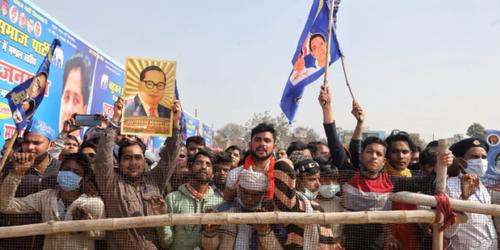
That restlessness has only intensified in recent weeks. What began as opposition to electoral arrangements and broken agreements has evolved into one of the largest civil mobilizations in Pakistan-administered Kashmir in recent memory. Across Rawalakot, Muzaffarabad, Mirpur, Kotli, and Pallandri, people have resisted through the language of collective action: shutter-down strikes, wheel-jam protests, sit-ins, road blockades, long marches, and calls for election boycotts. Traders have closed their shops, students have joined demonstrations, lawyers have marched alongside laborers, and entire communities have gathered in public squares despite curfews and communication blackouts.
The response has been severe. Internet and mobile services have been suspended repeatedly. Hundreds of activists have reportedly been arrested. The JKJAAC has been designated a proscribed organization under anti-terror legislation. Journalists have faced restrictions, and access to affected areas has become increasingly difficult. While official figures remain contested, independent reporting suggests that at least thirty people have been killed since the protests began, with local human rights groups and movement leaders placing the number considerably higher. Each passing week appears to widen the distance between state narratives of stability and the realities experienced on the ground.
Yet perhaps the most striking feature of these protests is what they are not. They are not a movement for India. Nor are they a celebration of Pakistan. They are, above all, an insistence on political dignity. The slogans emerging from the streets are not simply about electricity tariffs or reserved assembly seats; they are about Haq-e-Hukamrani, the right to govern one's own affairs, and Haq-e-Malkiat, the right to exercise ownership over one's resources and future.
For decades, Kashmir has been spoken about by others: by diplomats in New York, by politicians in Islamabad and New Delhi, by television anchors and military strategists. The people marching today are rejecting that arrangement. They are asserting something both simple and radical: that Kashmiris are not merely the subjects of history, but its authors.
The bleeding continues. And until Kashmiris on both sides of the border that they did not draw are permitted to determine the conditions of their own political existence, normalcy will remain what it has always been: a carefully maintained illusion.
This article is authored by Qandeela Qudoose pursuing her B.A. degree in Sociology Hons. from Jamia.
Disclaimer: The opinions expressed in this Publication are those of the author. They do not purport to reflect the opinions or views of The Jamia Review or its members.