Between CAA Violence and Calls for Cannon Fire: The Systematic Targeting of Muslim Universities

Ateerah Ahmed
Published

How State-Sanctioned Campus Invasions in 2019 Paved the Way for Yati Narsinghanand's Demand to Destroy Educational Institutions- this article contends that educational spaces have been systematically transformed from protected zones of learning into legitimate targets of communal warfare, with Muslim universities now conceptualized as civilizational threats rather than academic institutions.
By summoning the Indian Army to blow up four Muslim universities with cannons, Yati Narsinghanand Giri was not delivering another inflammatory speech; the guru of Dasna Devi Temple was pointing to an ominous shift in the communal politics of India: the shift of university campuses into ideological battlegrounds where universities themselves now transform into targets for wider cultural war.
His pronouncement, “Terrorist dens like Al-Falah University, AMU, Jamia Millia, Darul Uloom Deoband should be blown up with cannons by sending in the army”, comes at a time when universities in India are being increasingly reconfigured as a source of threat to national security, religious identity and social order. It is a much more dangerous type of rhetorical transformation than individual hate speech: it marks the normalization of targeting universities in propaganda campaigns of religious character.
The university campus has become, perhaps, the most controversial ideological place in modern India, carefully re-packaging intellectual discourse and academic freedom in a communal flavour, whereby Muslim schools are no longer seen as a source of learning but as a breeding-ground of extremism, disloyalty, and anti-nationalism.
The catalyst for Narsinghanand’s comment was the explosion at Red Fort on November 10 causing the death of at least 15 people. Caused by ammonium nitrate fuel oil in a vehicle, the explosion has been formally labeled a "terrorist attack " and investigations suggest that some suspects have connections, to Al-Falah University including the purported suicide bomber. Extensive operations have been conducted by the National Investigation Agency and Enforcement Directorate with a minimum of 200 doctors and personnel currently being examined.
Nevertheless his reaction was not limited to Al-Falah, subject to an active criminal probe. He extended his remark to three universities, which were entirely unrelated to the attack: AMU, Jamia and Darul Uloom Deoband. This broadening reveals the reasoning behind the actions, which is less about targeting specific criminal deeds and more about holding an entire community collectively responsible, via its educational institutions. When universities are successfully established as being “terrorist dens”, violence against them becomes not merely admissible but unavoidable.
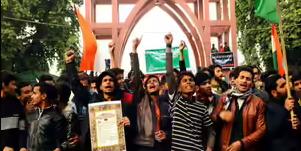
To examine how we arrived at this juncture, we need to trace the history of the process of targeting universities, and December 2019 marks a defining break. The protests of the Citizenship Amendment Act demonstrated that muslim universities were not merely targets of rhetoric, but also State invasion, with scant surveillance, transforming them into de facto conflict zones.
On December 15, 2019, hundreds of police officers raged into the JMI campus without authorization, deploying batons and tear gas on students inside the library and washrooms, with images of students being dragged and beaten were aired on news television. However, the violence at Aligarh Muslim University seems to have been even more communalistic in nature. A fact-finding report revealed that police shot stun grenades "usually used in war-like situations or terror operations" at students and had brazenly raised such chilling slogans as “Jai Shri Ram”.
When Narsinghanand now appeals for military strikes on these universities, he is tapping into the reservoir of state violence and communal discrimination that has been filling up for years. The December 2021 Haridwar Dharam Sansad that he organized, included at least two speakers who called for genocide against Muslims- a development protested by 76 senior lawyers and judges and retired military leaders on grounds of national security. He was arrested in January 2022 but granted bail and resumed incendiary speeches. His derogatory comments about Prophet Muhammad in October 2024 sparked demonstrations across cities leading to the filing of multiple FIRs afterward.
What makes his focus on universities striking is the fact that it echoes a wider narrative, one pitting civilizations against each other. Under this context, universities do more than educate students; they perpetuate identity and consequently civilizational difference. The representation, therefore implies that Muslim universities are not merely producing citizens but prospective enemies.
This is the reason his claim affiliates Al-Falah, now under scrutiny, with AMU, Jamia and Deoband none of which have any accusations, labeled as "terrorist dens" not based on proof but because of what they symbolize: the continuation of Muslim identity, via education.
When a spiritual leader is able to demand the military to shell universities- not figuratively but literally, using artillery- and does not endure significant penalties, it indicates that the theoretical barrier between political speech and acts of violence toward academic establishments has been transcended. The fact that such assertions are being openly voiced, documented and shared implies an assurance that no serious retribution will result.
A question now faces India: whether educational institutions can be reclaimed as spaces fundamentally separate from communal politics or will continue to be proxies in a larger civilizational conflict. Narsinghanand's statement, and the relative impunity with which he makes it, suggests the latter scenario is becoming normalized.
Ateerah Ahmed is a student pursuing English from Jamia Millia Islamia.
Edited by Arslaan Beg