
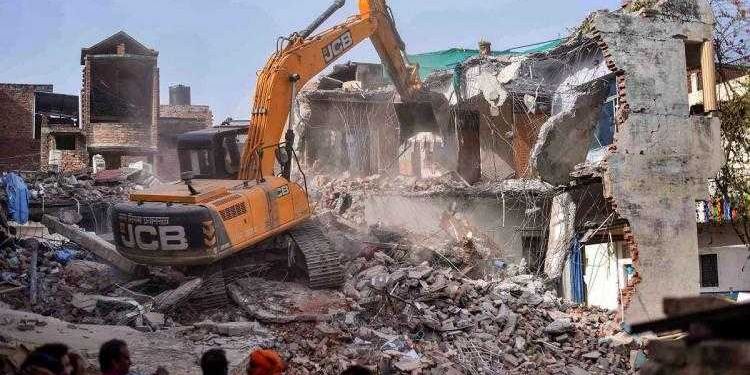
The Indian State legitimises the demolition drive through its discourse of legality. Here, however, the State takes up the role of a neutral judge. This article takes an entirely opposing stance and claims that the discourse of illegality is used as a technology of space production, which does not identify violations of the law but instead decides who gets to live in the ambivalent space created by the law. Muslim neighbourhoods in India have twice been made homeless: initially deprived of their structural capability of getting formal housing rights due to centuries of State indifference, discrimination, and violence, and ultimately demolished because of the informality that they were forced into. The bulldozer, in this reading, is not an instrument of urban governance but the final act in a longer drama of spatial exclusion whose earlier acts were carried out through indifference, discrimination, and the slow withdrawal of the State from areas it had already deemed expendable. Illegality here does not reveal itself; it is constructed and imposed.
A critical misunderstanding of urban informality is the belief that it exists as an entity external to the formal economy. The popular discourse around urban informality presents it as something external to the city, or as a residue of incomplete development. But if that were true, if the informal economy was truly external to the urban economy, its removal would have led to its collapse long ago. The thela-wala who parks his cart illegally outside the upscale market feeds the workers who stock its shelves. The dhobi who dries clothes on a patch of encroached land services the households of those who live in legally titled apartments. The construction worker who lives in a settlement with no legal tenure builds the city that later obliterates him from its memory. These are not marginal figures in the urban economy. They are, in fact, its load-bearing infrastructure.
It must be emphasised here that the State is very much aware of this phenomenon. Urban planners, urban labour offices, policies addressing informal economies- all of them acknowledge the structural significance of informal livelihoods. For decades, India’s erstwhile Planning Commission (now NITI Aayog) has recorded how informal economies dominate urban employment. It is not possible to govern a city without knowing where its marginal labour force lives. The State does not merely tolerate illegality in this sense; it licenses it through the gradual aggregation of permissions through non-enforcement. When the Delhi Development Authority “regularises” such colonies before an upcoming election, it is not extending mercy; it is codifying the truth that has always been operative- that legality cannot be possessed; it is a process that is accessed, along the lines of class, caste, and political patronage. Demolitions in India are also governed by predictable geographic and social criteria, regardless of how such operations attempt to be dispassionate exercises in urban governance. There are clear patterns to where and to whom the bulldozer comes. It arrives in economically disadvantaged areas, where residents are either Dalits or Muslims, and where the price of land has escalated due to proximity to infrastructure development or real estate investment. The bulldozer, therefore, functions not as the consequence of a legal process but as its substitute, as punishment administered through the idiom of urban planning.
The operation of demolition politics against Muslim minorities in India cannot be merely analysed through the political phenomenon of the bulldozers. Rather, one must trace its historical trajectory. The spatial condition characterised by the State as “illegal” is a result of decades of systematic state neglect and exclusion through communal violence. Ghettoes, therefore, did not appear but emerged over time by the same institutions that now use them as legal justification for erasure. The Sachar Committee Report of 2006 provided a review of the socioeconomic status of Muslims in independent India, which revealed that these localities received less infrastructural investment, and even banks were hesitant in granting loans because it was considerably “risky”. The riots that dot the pages of Indian urban history- Ahmedabad, Bhagalpur, Mumbai, Muzaffarnagar, and several other places that are no longer part of public memory- do not just destroy, they recreate.
In the wake of violence, Muslim families tend to settle in neighbourhoods which are perceived to be relatively safer, meaning existing muslim-majority neighbourhoods. As the population density grows through time in a locality surrounded by fixed, and often unclear, legal boundaries, it acquires the spatial discourse of “unauthorised” space. The pattern that arises out of this history is an unbreakable cycle of deprivation and abuse. The State removes itself from any investments in infrastructure in Muslim-dominated areas. Communal violence drives them towards a higher concentration within those deprived regions. That high concentration results in illegal constructions, transactions, and an illegal arrangement of space, since anything legal is out of reach.
The double irony is inherent in the language of illegality, as it was designed precisely to obscure it. The first layer involves when Muslim areas are labelled as disorderly and disorganised spaces as per the classical lexicon of ghettos. Such descriptions have the effect of reinforcing the idea that these areas should be left without any governmental intervention, thus exacerbating the very problem being described. The second layer proves to be even more tragic since it is the very informal nature of this space, as created by the lack of governmental involvement, that leads to its demolition. The demographic is first labelled as illegality by a deliberate orchestration of neglect, and then punished for the illegality that neglect produced.
After the riots that occurred in Jahangirpuri (Delhi, 2022), Khargone (Madhya Pradesh, 2022), and various other places where communal disturbance took place, bulldozers arrived shortly to raze houses and shops in the area. Not to the houses of the people found guilty of instigating the riots, but those of Muslims living in the area, who had not come into notice until the riots. The demolition is not caused by the law but by the riot. The law simply acts as its language.
What this tells us is that the destruction of Muslim spaces operates not just as an exercise in the expulsion of bodies but as a statement, as an act, conducted in public and recorded on camera, which says that Muslim presence in the city is provisional, reversible, and ultimately subject to the benevolence of a state that has firmly positioned itself behind a majority political project.
It must be recognised here that the second spatial effect that it produces is the impact on Muslim communities that survive. For when Muslim homes are destroyed, through rioting or "anti-encroachment" measures, the surviving Muslim community is pushed closer into the pre-existing Muslim ghetto. The demolition does not disperse the ghetto; it reinforces it. At once reducing the spatial area in which Muslim existence is permitted, the demolition at the same time creates the necessary conditions for a future wave of "illegal structures," ripe for destruction in due course.
The most comprehensive recording of demolitions is evident from the one-year observation conducted by Frontline Magazine in 2024, where there were reports of forty-eight demolitions due to violations of housing laws in sixteen states and union territories, amounting to the razing of 7,407 homes and displacing approximately 41,085 individuals. Among these demolitions, almost 37% of them had been directed against Muslim properties and areas in particular, exceeding the number of Muslims residing in the urban areas of any of the mentioned states. Furthermore, it was concluded that one out of every four cases recorded by the study had been punitive in nature. The demolition process was undertaken not to undertake an urban plan but rather to punish Muslims who were allegedly responsible for communal incidents.
After violent episodes took place in the context of a Hanuman Jayanti processional event, bulldozers rolled into Jahangirpuri, a Muslim-dominated locality in Northwest Delhi, in April 2022. In response, the Supreme Court granted an injunction against demolition activities. But for the next hour, officials proceeded with the destruction of buildings, including the gate and staircases of a local mosque, until reaching the doorstep of a nearby temple, which stood some fifty metres away.
In Ahmedabad in 2024, municipal forces destroyed 8,500 homes in the Muslim-dominated locality of Danilimda as part of the drive to identify "illegal Bangladeshis." This use of illegal immigration as a secondary reason, superimposing a status of encroachment on the status of foreigner, constitutes a significant shift. It represents yet another element of illegibility layered onto a community living under a status of informality, the suggestion that these people are not just illegally occupying the city, but are also illegally present within it.
The demolitions of Chandola Lake houses in Ahmedabad in 2025, coming in the wake of the Pahalgam terror attack, similarly proceeded from the same assumption: the state referred to issues of national security and the presence of "illegal Bangladeshi infiltrators," thus conflating notions of informal housing, Muslim identity, and external threat into the same statement justifying the demolitions as both unavoidable and morally justified.
On May 24, 2026, bulldozers, escorted by the police and higher government functionaries, descended on the Sirsi region of Sambhal district to raze the Sher Ali Baba Peer mazaar – a local shrine – alongside an additional tomb-like structure. Government officials referred to the mazaar as an "illegal shrine constructed by individuals on government-owned property," indicating that "an attempt was made to lay a permanent claim over the region through construction of a small shrine." Such interpretation, where building a shrine by a certain group constitutes a territorial plot rather than an expression of faith, encapsulates the fundamental interpretive process at the heart of all demolition actions: Muslim territory practices, per se, constitute threats.
It was the state that built the ghetto. Today, it is photographing the process of its demolition and branding it as urban development. And here lies the peculiar brutality of the logic: the community will never win. If you move out of the locality, you erase your past. If you stay and build, you will be infringing on others. Large shrines will make you legally guilty. Small shrines will establish territorial claims. Laws are amended so that no matter what Muslims build, it will be illegal. Illegality does not come as an accidental condition in which these communities find themselves. It is being deliberately crafted for them through each bylaw, notice period and public interest litigation case. What is being demolished in such processes is not buildings and constructions alone. They are memories, the concrete expression of the community’s life within the city- the lanes in which children grew up, the shops constructed by their grandfathers, the mosques at which Eid prayers were held and funerals conducted, the shrines that transformed pieces of land from mere occupation to inhabitation. This is not an era of urban planning in India. It is an era of politics in which the rhetoric of the law is used to do that which, properly understood, the law forbids. The bulldozer is the tool. The encroachment notice, the excuse. And the communities that are being dispossessed of the land are not being done away with for their buildings. They are being done away with for who they are. There’s a name for this sort of thing, when practiced in a democracy: Communal Violence.
Ateerah Ahmed is pursuing a master's degree in English from Jamia Millia Islamia.
Edited by: Omama Abu Talha
Disclaimer: The opinions expressed in this Publication are those of the author. They do not purport to reflect the opinions or views of The Jamia Review or its members.