
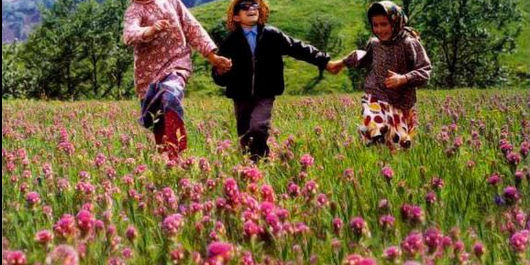
"Now I reach out to God everywhere for God till the day my hand touches him."
The color of paradise centers around a blind boy who is able to see more around him and a sighted father who is blind to everything that matters. Post revolution cinema in Iran has made a major breakthrough in the film industry and Iran has created many masterpieces. Majid Majidi stands out, as his productions are not like those typical movies with dramatic plots rather it just flows quietly like naturally a breeze brushing part of our skin, gentle but impactful and unforgettable.
Majid Majidi's cinema doesn’t shout but presents itself in a soft slow pace to audiences, it lets them think about the daily life tragedies in a nuanced manner. Similarly, his movie ‘The color of paradise’ follows the same pattern it stands as one of the profound works of Iranian cinema, weaving together simplicity, innocence, subtle spirituality, and social realism with remarkable emotional intensity and depth. The film tells the story of a blind 9 year old schoolboy Mohammad, whose pure perception of the world around him becomes a quiet form of wisdom. He experiences the world through touch, sounds and smell.
In the opening scenes,the school term is over and Mohammad is waiting for his father to come and pick him up. When his father takes him home for the summer vacations, the tension rushes through the air during their journey home making it clear for audiences how his father (Hashem) perceives him as a burden, an obstacle in his pursuit of remarriage and social acceptance. Yet, he returns home brimming with curiosity and innocence, where his grandmother and two sisters are waiting for him to welcome him. The movie offers a unique and quiet raw perspective on the beauty of the Iranian countryside.
Mohammed finds joy in nature, hearing the colors of nature through touch and sound, for him every touch has a meaning and every sound has a colour. Majidi has beautifully captured this, the way Mohammed tilts his head to catch a sound, or smiles at the texture of nature; these are simple yet deeply poetic. One of the strongest elements of film is nature, trees, streams, wavy breeze, birds chirping. They aren't just background scenery, rather they play the role of being silent companions to Mohammed.
Majid Majidi has also depicts how modernity and social acceptance standards make his father soulless and indifferent to Mohammed. Mohammed and his father seem to exist in contradiction,where one is physically blind and other innately. Thus, the movie concludes that blindness is not merely absence of sight but it is the purest form of it.
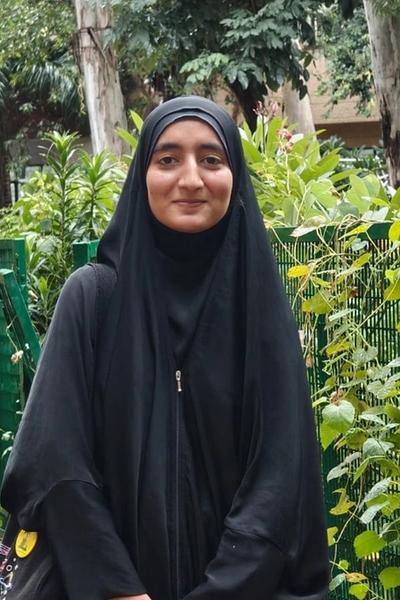
This is written by Toyiba Yousuf, a Bachelor’s student at Jamia Millis Islamia, pursuing a multidisciplinary degree.
Disclaimer: The opinions expressed in the publication are those of the author. They do not purport or reflect the personal views of The Jamia Review or its members.