
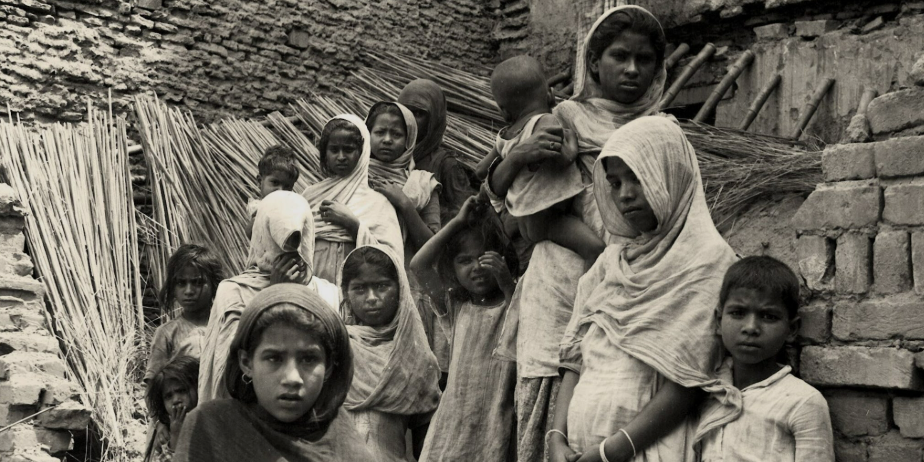
This article aims to explore the literature on partition that proffers people with a perspective on women’s agency, dehumanisation of women, and the cruelty they endured during the partition. The oral testimonies and accounts employed by feminist writers like Urvashi Butalia, Kamla Bhasin, and Ritu Menon to narrate untold horrific events that occurred in the years that led to the partition have been a poignant and limited source that portrays women's brutality. By putting women in the centre of the partition, the aforementioned writers describe partition not as a political division but a gendered human catastrophe.
When a flock of bar-headed Goose or the Siberian crane flies from their homeland to a distant or alien land because of weather changes, we call it migration. However, when the largest human displacements occur, when not one but millions of people have to abandon their soil, their life, their relations and families to go live somewhere they have nothing to grasp onto- we fail to give it meaning or terminology. The partition of India in 1947 is often described as one of the greatest migrations, but the people who left India and went to the other side or the people who came to India from across the border, were not ready for the migration like flocks of birds. The displacement was the result of years of communal riots and tension; it was as historical as it was political. Both countries, to this date, continue to fight the horrors of the partition. As the devastation unfolded, we saw a great deal of something which was not political or historical, but emotional and psychological. The psychological aftermath of the partition led to the development of “Oral Histories”. The oral accounts of events enabled the survivors to tell the repercussions of political agendas on ordinary human lives and how some events of the past cannot be determined by official records.
The documentation of human sufferings of the partition in literature has paved a way for people who were afflicted by the partition as well as for the people who were just witnesses of the horrid event, to resonate or to understand what happened in the years that led to the violence and what actually happens when 14-15 million people get displaced in a mere few days. But since writers and officials have always been more empathetic towards the sufferings of men in particular, given that any event in history is directly a result of what “men” do, which is perhaps true and affects only men, which is almost always wrong, the partition literature in the early days had reflected this discriminatory documentation of human suffering.
Feminist writers of the time gave voices to the voiceless women who suffered not just the partition, but the horror of being born a woman. The “other side of silence” by Urvashi Butalia traverses through different stories of women during partition, from silent victims to trauma hidden in domestic lives to communal fights within families to violence that occurred in the name of “honour”, the book echoes the silenced victims of the partition. One of Butalia’s stories narrates the story of a sikh man who killed all the women in his family because he feared them getting raped by the rioters. The impact of murdering your own family members in an act of impulse induced with fear and systematic patriarchy on the human psyche cannot be comprehended in mere words; a daughter being murdered at the hands of her own father cannot be documented in a text. The undocumented sufferings of women were those that women were abducted in broad daylight by the men of the “other community” and raped and murdered because a woman represents “honour” which they get raped for, and that same honour is stripped off of her when men deems them convenient. Some accounts in her book describe how partition was not a momentary event that came and went; its scars were/are carried out by the ones who survived, by the children who lost their entire families and crossed borders alone, by the families whose family is yet to be completed because half of them were left on the other side of the border. The doom of the survivors is that they don’t survive; they live the same suffering through the years, till they die.
“Twelve million people were displaced as a result of Partition. Nearly one million died. Some 75,000 women were raped, kidnapped, abducted, and forcibly impregnated by men of the ‘other’ religion, thousands of families were split apart, homes burnt down and destroyed, and villages abandoned. Refugee camps became part of the landscape of most major cities in the north, but, a half century later, there is still no memorial, no memory, no recall, except what is guarded, and now rapidly dying, in families and collective memory.”
~Urvashi Butalia
Kamla Bhasin and Ritu Menon, in their co-authored book, “Borders & Boundaries: Women in India's Partition”, narrate the Partition from a feminist and gendered lens. Through oral testimonies alongside official records and recoveries, Bhasin and Menon describe the brutality against women not as something that happened in a flick, but something intentional, systematic and symbolic. When women are abducted, raped and converted in the name of politics, honor and reclaiming authority, it is intentional and symbolises how women are deemed and treated as pawns in the games men so like to play.
“Abduction was central to partition, not accidental”
“National honour was protected at the cost of women’s lives”
~ Borders and Boundaries
And so, when the flock of humanity fled from one side to the other, when the flock couldn’t remain a flock and were divided in communities- life long camaraderie forgotten and hatred taking refuge in humanity’s core, there was one community which remained together, battling the same horrors and fighting the same regime that makes them voiceless and that community was of the women. Women across borders in both countries suffered multiple atrocities at the hands of the “other community”, and that was the community of men. Women throughout history have been silenced, their voices muffled, their faces smeared, and their lives brutalised in accordance with the demands of the oppressor. The partition is one such account of women’s suffering, which saw a ray of light because of feminist writers of the time.
Sufia Siddiqui is a student pursuing English Literature at Jamia Millia Islamia
Edited by: Omama Abu Talha
Disclaimer: The opinions expressed in this publication are those of the author. They do not purport to reflect the opinions or views of The Jamia Review or its members.